Archbold Air Support

DCIM101MEDIADJI_0166.JPG

A photo of Archbold Biological Station taken during sunrise. Photo by Kevin Main.

Author: Paul Ruben

Archbold Biological Station continues to implement new data collecting technologies using Unmanned Aircraft Systems (UAS), commonly referred to as ‘drones’. The Archbold Drone Program is expanding due to the kindness of generous donors, which allowed the Station to recently hire Geographic Information System (GIS) Research Assistant Paul Ruben. Ruben joins a small group of Archbold staff and consultants who are FAA Part 107 certified drone pilots. “I’m excited to work for such a storied science and conservation organization and to have the opportunity to use the newest technology in my field,” said Ruben. “Honestly, it’s a lot of fun and really amazing what drones are capable of teaching us,” he continued while watching a drone fly overhead on a mission to map the details of an earlier prescribed burn on the Station. “We use drones to map the boundary of a prescribed burn and document the fire intensity where the burn spread across different plant communities”.

Continue reading

Weather, Weather, Weather Data

week149_photo1_weatherprez

Main Weather Station at Archbold Biological Station. Photo by Kevin Main

Author: Kevin Main

Weather data have been collected at Archbold Biological Station for nearly 90 years,” said Kevin Main, Land Manager for Archbold. “We have daily high and low temperature, and daily rainfall going back to 1931. In 1982 additional sensors were added to measure humidity, soil temperatures, and evaporation, and in 2006 we got an automated system that records even more detailed weather data.” The Station currently records 15-minute data for temperature, rainfall, relative humidity, wind speed and direction, soil temperature and moisture (at three depths), barometric pressure, and light intensity. Archbold uses the data in conjunction with the many research projects that require precise information about weather conditions and trends.

“Weather data are also useful during prescribed fires,” Main said. “I can access the data from my smartphone and look at trends in humidity, wind speed and wind direction during the day, which helps me make decisions for managing the fire.”

The Archbold weather station happens to be located in a rather cold spot. “I have received several calls over the years questioning our low temperatures. It can be 5-10 degrees colder at the Archbold weather station than other locations just a few miles away, and it’s not because of a faulty temperature sensor. We have two professional grade sensors on site, and both are always within a degree of each other,” said Main. “The record low recorded at Archbold was 13 degrees Fahrenheit, on January 12, 1982 and January 5, 2001. The temperature has sunk into the teens 23 days in the last 50 years. Snow was recorded for one day, January 19th, 1977, when a “trace” of snow was recorded.

While Florida certainly feels hot in the summer, the actual temperature rarely gets above 100 degrees F. The highest temperature recorded at Archbold in the last 50 years was 103 degrees F, on July 3rd, 1998. The daily high temperature was 100 degrees F, or higher, just 24 times since 1969.

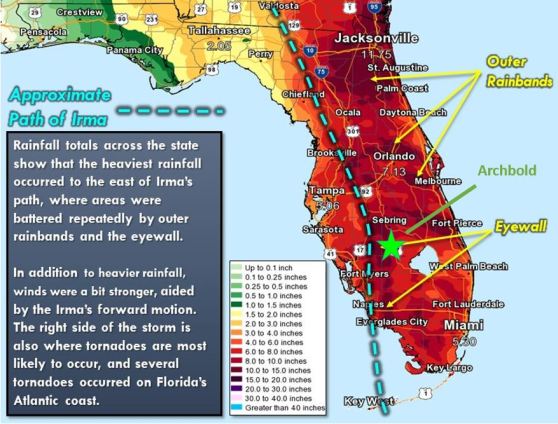
Hurricanes are a big driver of weather during the summer months. The weather station has recorded tropical winds and rain multiple times. The single largest rainfall event was caused by Hurricane How on October 2nd, 1951, when 12.15 inches of rain fell in a one-day period. The most recent hurricane to affect this area was Hurricane Irma, in 2017. Archbold received 8.89 inches of rain over a two-day period and had peak winds of 97 mph (which ended up being one of the highest reliable wind readings on the Florida peninsula during the passing of the storm).
week149_photo2_irma path

Hurricane Irma’s path across Florida. Archbold received heavy rains
and wind from the eastern eye wall of the storm. Photo credit: National Weather Service

Archbold’s weather data are provided to the National Weather Service through the Service’s Cooperative Observer Program. “We have been an observer station for the National Weather Service since 1969, and we recently received an award from them for 50 years of service,” said Main.

“The Archbold weather data are not currently publicly available online in real time from Archbold, although you can retrieve daily data from the National Weather Service”, says Hilary Swain, Archbold Director. “Data from private weather stations like Archbold can also be viewed on websites such as Weather Underground. Vivienne Sclater, who heads up data management at Archbold, is moving us over to a new data management system in the coming months and that should rectify some of the challenges of making more Archbold monitoring data available to the public in the future.” If you are interested in local weather, there are several other weather stations in this area that provide data. NOAA maintains a very extensive Climate Reference Network (CRN) station on Archbold property a little further south towards Venus with 15-minute data for many meteorological measurements. (https://www.ncdc.noaa.gov/crn/station.htm?stationId=1530). Archbold’s Buck Island Ranch has an extensive network of weather stations and data from the Ranch’s main weather station are streamed to the US Department of Agriculture for posting online. The Florida Agricultural Weather Network (FAWN) is another source of weather data locally, supporting a weather station in Sebring and another in Palmdale (https://fawn.ifas.ufl.edu/) with publically accessible data.

The Bad Seed: A Tangled Tale

Week148_photo1_tangletop_roadside_edited

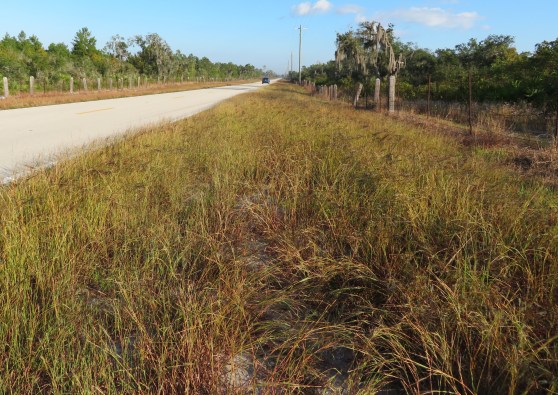
Dense stand of Tanglehead Grass along Old State Route 8 beside the Archbold Biological Station. Photo credit: Archbold Biological Station

Author: Mark Deyrup

As one approaches the Archbold Biological Station on Old State Route 8 both sides of the road are lined with dense even stands of knee-high grass. A distinctive feature of this grass is its clumps of messy blackish seed heads. The same grass can be found along many roads through Highlands County. While not unattractive to look at, woe betide anybody attempting to walk through this grass when it is producing seed, for they will end up with hundreds of sharp-pointed seeds working through socks and even through fabric running shoes. This plant is Tanglehead Grass (scientific name Heteropogon contortus). Tanglehead seeds also work their way into the fur of animals, and where tanglehead is abundant in other states it can prevent raising sheep because of the intense irritation caused by seeds penetrating the wool and lodging in skin.

Continue reading

A Big Batch of Beetles

week147_photo2_Epicautaheterodera_Palafoxia

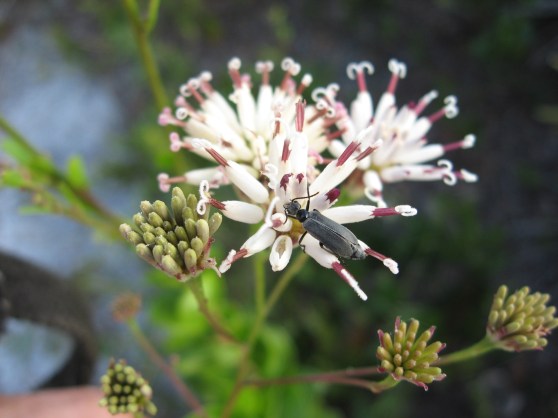
The Gray Blister Beetle Epicauta heterodera visiting flowers of Palafoxia for nectar and pollenPhoto Credit: Archbold Biological Station

Author: Mark Deyrup

The living world may be richer and more interesting than we imagine, so much so that it is a major challenge to formally assess this wealth. At the Archbold Biological Station scientists have recently measured one dimension of this rich living heritage. After much patient work in the field and laboratory, Archbold staff and visiting researchers have recorded and collected specimens over decades allowing compilation of a mammoth list of 1,709 different species of beetles that that have been documented on the Station. There is probably no other site in North America with such a comprehensive specimen-based catalog of beetles.

Continue reading

Spiders at Archbold: What Has Been Learned in Past 70 Years

Week 143_Photo 2 by Giff Beaton

Female Workman’s Jumping Spider found on low growing shrubs in dry, open scrub and sandhill habitats on the Lake Wales Ridge. Notice bright green jaws.
Photo by: Giff Beaton

Author: Jim Carrel

In the past three years information about every spider species archived in the museum collection at the Archbold Biological Station has been computerized. Each listing for 482 preserved individuals includes the spider’s scientific name (taxonomic family, genus, and species), latitude and longitude for where it was collected, as well as the month and year it was found. This information recently became available free-of-charge to anyone in the world at the web site Global Biodiversity Information Facility (www.gbif.org).

Continue reading

Helping Rare Plants Survive

Week142_Photo 2

From left to right: Angela Soto, Megan Verner-Crist, and Lexi Siegle-Bates wrap up the project.
Photo Credit: Katherine Charton

Author: Lexi Siegle

This summer, biologists with the Plant Ecology Program at Archbold Biological Station were on a mission: to bolster a newly discovered population of a rare mint plant called  Scrub Balm (Dicerandra frutescens). The property where the new population was found is near Lake Placid and managed by the Florida Fish and Wildlife Commission. It was recently surveyed for rare plants. When the previously undocumented population of Scrub Balm was found, biologists were excited about the discovery since only a dozen populations of this rare plant were already known. There were, however, very few plants in the newly discovered population, meaning it was vulnerable to extirpation. Thus began a plan to augment the population.

Continue reading

To Move or Not to Move, That’s the Frog’s Question

Week141_Photo 1

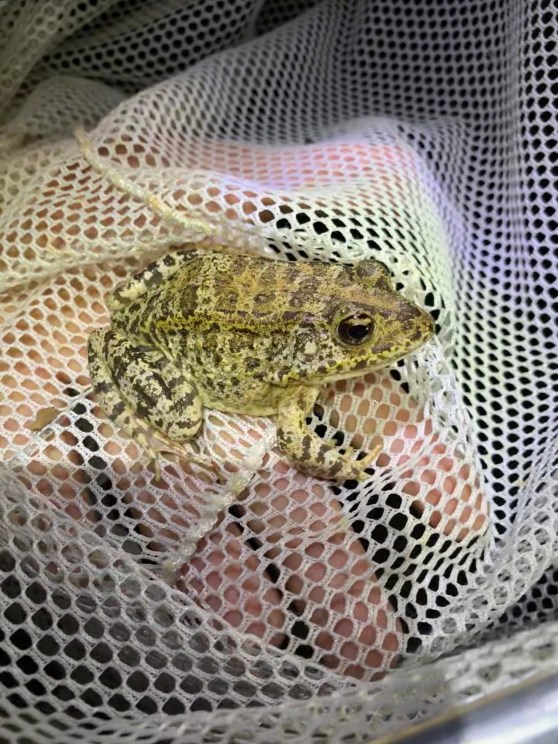
Adult Gopher Frog following capture. Photo by Garrett Lawson

Author: Garret Lawson

Habitat alteration is one of the greatest threats facing wildlife species that have specialized food and shelter preferences. Discovering whether—and how—native species use human-modified habitats is an important part of understanding their likelihood of persisting in changing landscapes. This is an especially interesting question for amphibians that use both aquatic and terrestrial habitats, like the Gopher Frog.

Continue reading

Archbold Students Disperse Far and Wide

Week140_Photo 1

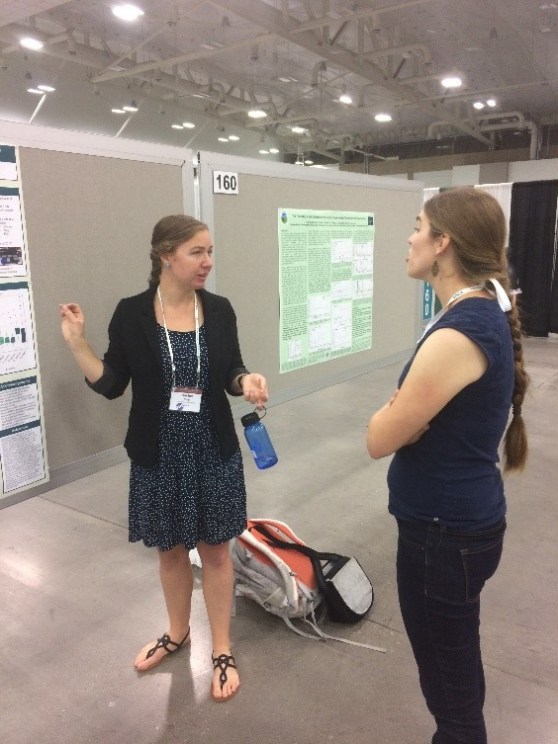
Rachel King (left) discusses her research poster with Jennifer Jones at the annual meeting of the Ecological Society of America.
Photo Credit: Eric Menges

Author: Dr. Eric Menges

Over the years, hundreds of students and scientists get training and research experience at Archbold Biological Station. What happens to all these bright minds? Many things, it turns out. Some are graduate students, some professors, some work for government agencies, and others for non-profits. But they never forget their Archbold roots. This August, thousands of ecologists gathered for the largest such conference, The Ecological Society of America’s  Annual Meeting in Louisville, Kentucky. Among them were over a dozen Archbold alumni.

Continue reading

Archbold joins Ranch to Ridge Expedition traversing Highlands and Polk Counties

Week144_Photo1_Ranch2RidgeWatercolor_CreditFlrodaWildlifeCorridor

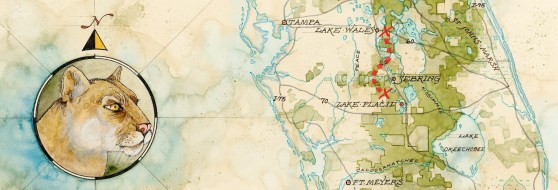
The route of the 2019 Ranch to Ridge Expedition from Highlands Hammock Park to the Tiger Creek Preserve. Photo Credit: Florida Wildlife Corridor

Author: Hilary Swain

On Saturday, October 19, three intrepid Florida Wildlife Corridor explorers, Carlton Ward Jr., Mallory Dimmitt, and Joe Guthrie completed the final day of their 7-day 2019 expedition south to north through Highlands, Hardee, and Polk County. Joe Guthrie described their route: “We started in Highlands Hammock State Park, going west of the Ridge, turning north to traverse private ranches and public lands on foot and horseback, then trekked east across US 27 near the Frostproof junction into a conservation bank and state and federal lands, and ended up on paddleboards at The Nature Conservancy’s Tiger Creek Preserve on the Ridge near Lake Wales.”

Continue reading

Teaming Up for Global Grasslands

Week139_Photo2

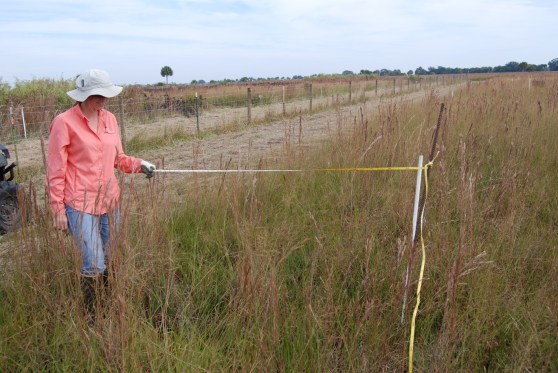
Dr. Betsey Boughton, Agroecology Research Director at Archbold’s Buck Island Ranch, monitoring plant species composition in the grassland experiment.
Photo Credit: Research Intern, Jessica Patterson

Author: Dr. Betsey Boughton

Grasslands make up more than 40 percent of the world’s ice-free land. Grasslands are important because they have sustained humanity and thousands of other species for centuries. But today, those grasslands are shifting beneath our feet. Global change—which includes climate change, pollution and other widespread environmental alterations—is transforming the plant species growing in grasslands, and not always in the ways scientists expected. Continue reading