Where has the night gone? The perils of light pollution

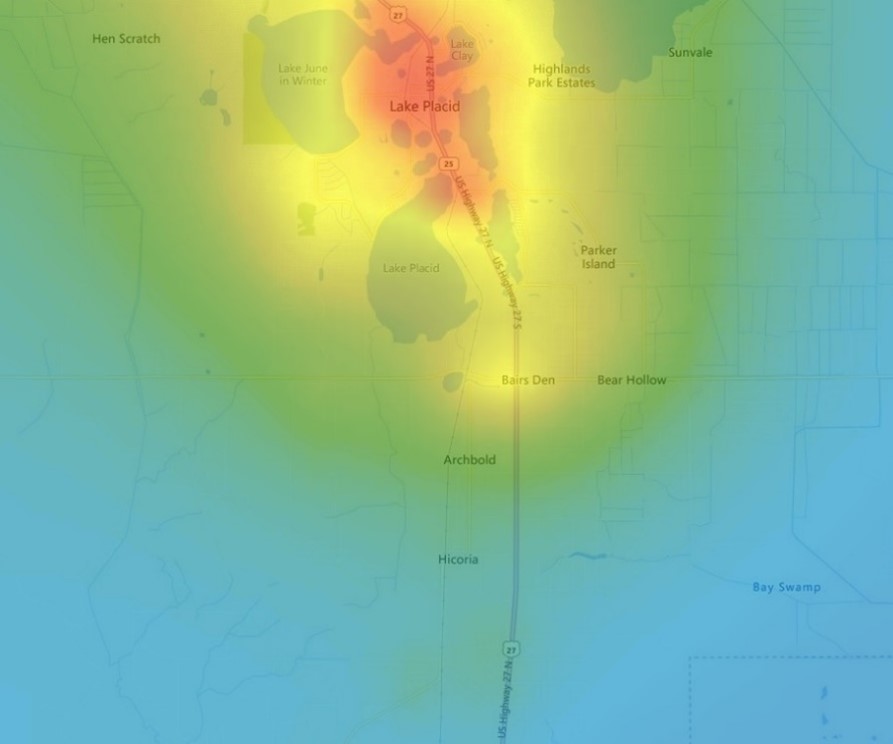
A light pollution map of Lake Placid based on data published June 10, 2016 (Falchi et al., Sci. Adv., Jakob Grothe/NPS contractor, Matthew Price/CIRES). You can view the light pollution map for other areas by visiting https://cires.colorado.edu/Artifical-light

Author: Zach Forsburg

If you live in or near a city or town, chances are the night sky you see is not as dark as it should be. The reason for the disappearing night is ‘Light Pollution.’ A growing problem across the globe, light pollution is the excessive use of artificial light that alters natural light/dark cycles in the environment. It is estimated that more than 80% of the world’s population lives in areas polluted by light, and nearly 99% of the continental United States is exposed to some level of light pollution. There are several categories of light pollution, including ‘glare’ due to excessive brightness, ‘light trespass’ when light illuminates areas where it is not intended or needed, and ‘sky glow,’ the brightening of the night sky. Though first recognized as just a nuisance in the 1970’s by astronomers, only recently has light pollution been recognized by scientists as a significant threat to biodiversity. Light pollution has become one of the most chronic human-caused disturbances to the environment, having far reaching effects on wildlife.

Until the invention of lightbulbs, wildlife evolved and adapted to ‘day and night’ light cycles, so it is not surprising that light pollution negatively impacts wildlife. Many physiological and behavioral traits are tied to natural light and dark cycles, which are disrupted or altered when light pollution is present. For diurnal species, melatonin and serotonin levels may drop during nighttime hours if excessive human-caused light is present. Songbirds in the city or rural areas exposed to light pollution will start their morning calls before the sun rises and might even start laying eggs too early in the season, because their sense of time and season is disrupted by constant light exposure. Constant light effectively eliminates night, disrupting nocturnal species like frogs and salamanders. Frogs in areas of intense light pollution experience increased stress, which can negatively impact growth and mating and diminish their ability to cope with diseases or predation. Nocturnal salamanders exposed to light pollution will continue to hide after dusk and reduce the number of hours spent foraging.  Many people are aware of the disorienting effect that heavily lit beaches have on sea turtle nestlings and this example provides the easy solution to light pollution.

There are several ways you can help reduce light pollution in your area, and in doing so help reduce the negative impacts it has on wildlife. The first, and easiest, way is to simply turn off outdoor lights when they are not necessary. If lights must be used outside, make sure to install light fixtures as low as possible. Tall light posts contribute to light trespass and sky-glow by illuminating more than the intended area, so using shorter lamp posts or footlights along a path reduces the amount of wasted light. Additionally, motion sensors, dimmers, and shields can be used to reduce light pollution and focus the light to where it is needed. Lastly, using longer-wavelength LED lights rather than bright-white or blue heavy LEDs helps reduce the negative impacts of light pollution, as animals, including humans, are more sensitive to blue-white light (think TVs and smartphones).

When Archbold Biological Station built two state-of-the-art buildings, known as the Adrian Archbold Lodge and Frances Archbold Hufty Learning Center, the decision was made to install wildlife friendly lighting. Archbold installed low footlights along the sidewalks with shields directing the light toward the ground, lights on motion sensors, and lights on the buildings that have shields to reduce or eliminate light trespass. Read more about the Lodge and Learning Center on the Archbold website: https://www.archbold-station.org/html/education/aac.html

Remember, don’t be like Tom Bodett, and DON’T leave the lights on!

Wildlife friendly light fixtures on and around the Frances Hufty Learning Center at Archbold Biological Station. Photo by Zach Forsburg.

Archbold’s Virtual Summer Camp returns for 2021

Archbold’s Summer Ecology ‘Club’ is not a membership, but a new and flexible format for attending online camp sessions and activities. Learn more at the Archbold Education website.
 

Authors: Dustin Angell and Margaret Davenport

It’s that time of year again! Archbold Biological Station is gearing up for the 30th year of Ecology Summer Camp and again the camp has evolved. Last year, Archbold offered virtual week-long science camps. This summer, as the country reopens, the Archbold Education Program presents a hybrid experience called the ‘Summer Ecology Club.’ This is not a membership club, but a new format for camp: For just $35, campers ages 7-12 can register for four weeks of activities either June or July and participate from anywhere. While most activities are virtual, campers are invited to an in-person Seasonal Pond Investigation event, as well. Thanks to donors, families can apply for financial hardship sponsorships that cover the camp’s registration fee. There is no limit per family, and many sponsorships are available.

The online component of camp includes variety of activities, such as: multi-week at-home projects, book clubs, science demonstrations, and nature film viewings. Meetings usually happen twice a day over Zoom and campers are welcome to pick which programs they would like to attend. “We wanted to create an educational experience that works with campers getting back into their regular summer fun,” says Margaret Davenport, Archbold’s Jill Abrahamson Memorial Environmental Education Intern. “Have plans to spend your afternoon swimming with friends? No problem, just hop onto our morning virtual nature walk! Busy in the mornings? Book club is at 1 PM for 7-9 year-olds and 3 PM for 10-12 year-olds! Our hope is to get students involved in science without forcing them to sit at a screen all day or ruining their summer plans.”

Virtual programs are also a great way to try something new. Archbold’s Director of Education, Dustin Angell explains, “Research has shown how important time in nature is for physical and emotional health, but many children don’t have the chance to receive those benefits. Maybe they or their family members worry about bugs or bad weather, snakes and alligators, or that they don’t belong. Virtual is the chance for them to give it a try without leaving their comfort zone.”

Angell is also proud of the improvements to the program, saying: “If you attended Archbold’s virtual camp last year, this summer’s program is the 2.0 version: new and improved. We have staff members from all different departments creating fun actives to teach about Florida Scrub-Jays, Gopher Tortoises, Florida Panthers, and local history. Plus, we are using immersive 360° imagery that campers can interact with on a mobile device, computer, or virtual reality headsets!”

The most exciting improvement of the ‘2.0 version’ of virtual camp: the ‘Summer Ecology Club’ is not completely virtual this year. Our campers will be the first groups to visit Archbold for a guided tour since March 2020. These events will be limited to 10 campers at a time, with multiple opportunities to get as many campers involved as possible. Participation is included at no extra cost.

Angell believes the Summer Ecology Club continues the spirit of Archbold’s three decades of camp. “Our summer programs have always been a VIP experience of our organization, and this year is no different. The children receive a behind the scenes look at research and conservation in Florida and make connections with the plants and wildlife that make it such a special place.”

To register for Summer Ecology Club, visit the Archbold Education website here: https://www.archbold-station.org/html/education/scrubecol.html 

Shaping future conservation scientists: How Archbold Biological Station is providing a variety of professional development opportunities to early career professionals

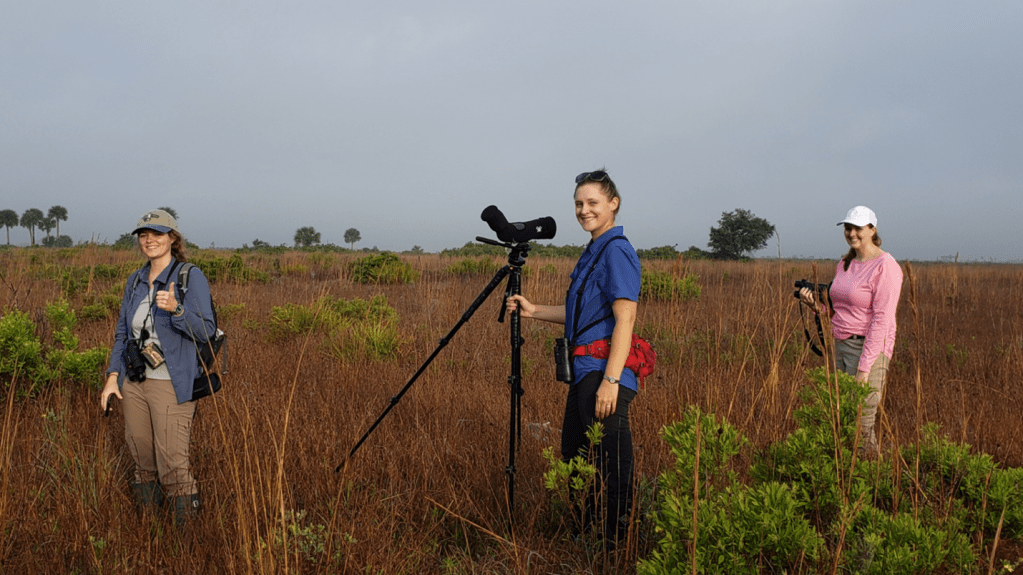
Chelsea Wisner Folmar (center) teaching intern Brittany Welch (left) and seasonal researcher Kaysie Gallup (right) how to conduct point count surveys for bird monitoring. Photo by Angela Tringali.

Authors: Chelsea Wisner Folmar, Greg Thompson, and Angela Tringali.

Archbold Biological Station is renowned for its long-running internship program. In fact, Archbold’s Post-baccalaureate Internship program is one of only a few programs in the United States in which recent college graduates can gain research experience before they commit to continuing their higher education or other career choices. Internships at Archbold provide exceptional opportunities for those who intend on pursuing a career in ecological research. Archbold also offers seasonal full-time positions in endangered species management, land management, habitat restoration, agro-ecology, and environmental education.

Internships at Archbold typically require a candidate to commit to living on-site for six to nine months and devote half their time being mentored and assisting with data collection for long-term research projects. Interns are compensated for their part-time work as well support for room and board. Additionally, interns are also afforded the opportunity to develop and execute their own independent research projects under the mentorship of professional scientists. This process is an effective catalyst for acceptance into graduate school, a typical ‘first step’ in beginning a life-long career in scientific research.

For those with career interests other than graduate school, or those who are seeking full-time employment, Archbold regularly hires full-time seasonal (~6 month) Research Assistants. In the Avian Ecology Program seasonal research assistants support permanent staff during the bird breeding season, when most of the endangered species monitoring and management work occurs. Seasonal staff work full-time under the direct supervision of staff researchers. This allows the year-round staff to meet heightened labor demands during the busiest time of year, and seasonal staff to expand their expertise in avian ecology under the guidance of experienced biologists.

New interns and seasonal employees of the Avian Ecology Program already possess some skills, like working independently in the field, but specialized skills are taught by full-time staff during the duration of their employment. Because working with Threatened and Endangered species requires permits from the US Fish & Wildlife Service, seasonal staff shadow full-timers, allowing them the opportunity to learn and refine skills including capturing and banding adult and nestling birds, taking biological samples, and nest searching and monitoring, all under the watchful gaze of experienced biologists. These highly specialized skills often become the qualifying experiences that propel seasonal Research Assistants into permanent employment in wildlife monitoring and management. 

Both internship and seasonal research assistant positions provide critical learning opportunities to early career professionals, and both allow for the opportunity to travel to Florida and become familiar with the plants and animals living here. Although these experiences appear similar on paper, they typically encourage different outcomes. Interns in the Avian Ecology Program often go on to graduate school to earn a master’s or doctorate degree whereas seasonal Research Assistants often pursue permanent employment in wildlife management, though some also choose to continue their higher education. Seasonal Research Assistant positions offered through the Avian Ecology Program provide a means of professional development that can be more accessible to a variety of applicants of diverse backgrounds and experiences, especially for those who are looking to gain full-time employment in wildlife monitoring and management. The Avian Ecology Program has nurtured the development of countless wildlife biologists working to conserve wild Florida as wildlife and land managers across the state. Do you know someone who has a future in wildlife conservation? Stay up to date on internship and employment openings at www.archbold-station.org!

Seasonal research assistants Abigail Valine (left) and Kelly Roberts (right) helping band Florida Scrub-Jay nestlings. Photo by Angela Tringali.

Archbold attends Highlands County Centennial Day

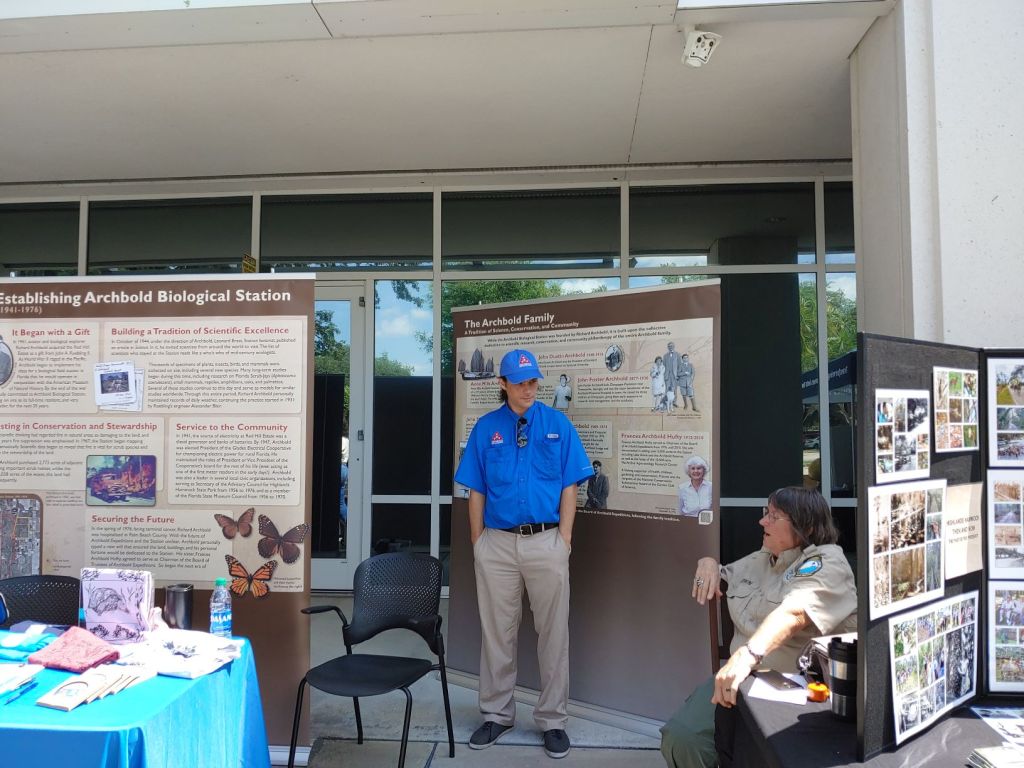
The Archbold Biological Station booth at the Highlands County Centennial Day celebration on April 23, 2021. Photo by Laura Mitchell.

Author: Joseph Gentili

Highlands County commemorated its 100th anniversary on Friday, April 23rd, 2021 with a Centennial Day celebration outside the Highlands County Government Center in downtown Sebring. Nine booths were arrayed representing entities that have played a part in the County’s history, and Archbold Biological Station was honored to be included as one of the nine.

Nearly 100 residents and visitors came to see the various displays. Archbold Librarian Joseph Gentili attended the Archbold booth for the event accompanied by Facilities Coordinator Laura Mitchell. Gentili stated, “The 100th anniversary celebration was a great chance to interact with community members and other organizations. Archbold’s booth contained three large displays which provide snapshots of the Station’s organizational history. One display featured the period of 1929-1941 when the Archbold grounds were known as the Red Hill Estate, the second discussed Richard Archbold’s life in Highlands County from 1941 until his death in 1976, and the final display highlighted the Archbold Family and in particular their history of philanthropy. As a decades-long member of the Highlands County community, it is always a privilege to share our story with the public.” Community members were encouraged to learn about Archbold’s rich history through viewing the displays and asking follow-up questions.

Archbold Biological Station has been a part of the Highlands County community dating back to John and Margaret Roebling’s original purchase of 1,050 acres of land near Hicoria in 1929. Listed on the National Register of Historic Places, the original Roebling buildings form the heart of the Archbold Biological Station campus. The Roeblings were generous members of the community and instrumental in the founding of Highlands Hammock State Park. They also helped with the purchases of multiple fire engines for the use in towns and cities in the County during the 1930’s. Richard Archbold continued this philanthropic legacy and contributed to the history of the county in numerous ways, perhaps most importantly by helping to found the Glades Electric Cooperative in 1947 and by serving as Glades Electric Board President or Vice President until his death. A long legacy of community engagement exists at Archbold and that tradition is proudly continued today with K-12 programs, summer camps and innumerable tours, talks and visits for the public.

Gentili, who serves as a member of the Historic Preservation Commission for Highlands County, noted, “A celebration like this one is a unique opportunity to look backwards on our collective past, while planning for what we all hope will be a brighter future. Archbold has been intricately linked with Highlands County for nearly all the last 100 years and enthusiastically anticipates being part of the county’s foreseeable future. It was my privilege to participate in this event while representing Archbold.”

Archbold’s Librarian Joseph Gentili standing by the Archbold booth at the Highlands County Centennial Day while chatting with Carla Kappmeyer-Sherwin, Park Services Specialist at Highlands Hammock State Park. Photo by Laura Mitchell.